South African Pet Food Rules Guide
South Africa uses a long-standing regulatory system to evaluate all dog and cat food sold in the country.
Every brand, from budget options to imported premium lines, must meet the same legal standards before entering the market. These rules help pet owners compare products, avoid low-quality feeds, and understand what goes into the food they buy. This article outlines the legal basis, the meaning of the V-number, labelling requirements, industry checks, and upcoming regulatory changes.
How South Africa Regulates Pet Food
South Africa uses a single law to regulate all animal feed products, including pet food.
This legal framework checks formulation, nutritional value, ingredient safety, and marketing claims.
It treats dog and cat food as controlled products rather than general consumer goods. This approach ensures consistency across the market and allows government inspectors to intervene when standards are not met.
The regulatory authority is the Department of Agriculture, Land Reform and Rural Development (DALRRD). It reviews formulations, issues registration numbers, inspects facilities when needed, and ensures that imports comply with local standards. DALRRD also monitors complaints and has the mandate to withdraw non-compliant products from sale.
Act 36 of 1947: The Core Law
The Fertilizers, Farm Feeds, Agricultural Remedies and Stock Remedies Act of 1947 (Act 36 of 1947) is the main law for pet food control. Although the Act predates the modern pet food industry, it still forms the backbone of South Africa’s regulatory system.
The Act applies to all dog and cat food that claims to be “complete,” “balanced,” or suitable as the sole diet. It also applies to complementary foods, treats, supplements, and imported products.
Under Act 36, manufacturers must:
- Register each complete pet food product.
- Supply full formulations to DALRRD for nutritional evaluation.
- Follow fixed labelling rules.
- Meet minimum and maximum nutrient thresholds.
- Imports must meet the same requirements as products made in South Africa. Foreign companies cannot sell pet food locally without registration and approval.
Why the V-Number in Pet Food Matters
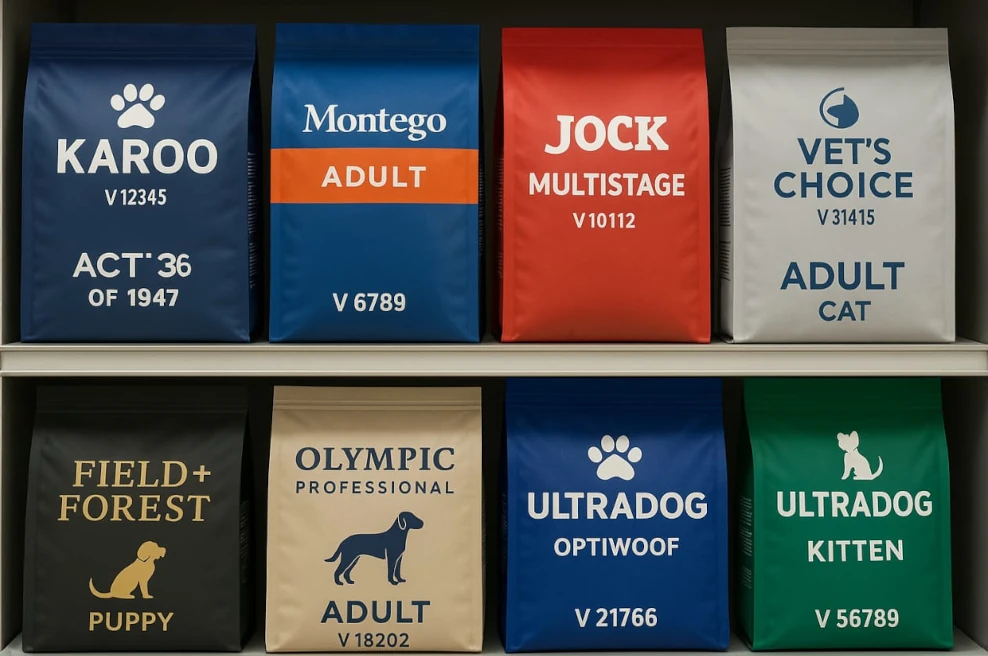
A V-number is the clearest sign that a pet food is legally registered. It is printed on the packaging and appears as “V####” next to the statement “Act 36 of 1947.”
The V-number shows:
- The product has been registered as a complete pet food.
- The formulation was evaluated by a qualified technical advisor.
- The nutrient profile meets minimum legal requirements.
- The manufacturer or importer meets traceability and compliance rules.
A registered product keeps its V-number for three years before renewal. Renewals ensure that outdated or changed formulations are reassessed. If a product has no V-number, it cannot legally be sold as a complete food in South Africa.
What Must Appear on Pet Food Labels
South African labels follow a fixed structure.
These requirements allow pet owners to compare products with ease. Each piece of information serves a specific purpose for safety, nutrition, or traceability.
Product Description
The description must identify:
- Species (dog or cat)
- Life stage (puppy, kitten, adult, senior)
- Whether the product is complete or complementary
- Life stage designation links directly to nutrient targets. For example, puppy and kitten diets must meet growth requirements that differ from adult maintenance diets.
Guaranteed Analysis
This section shows nutrient levels measured through controlled laboratory methods.
It must include:
- Crude Protein (minimum)
- Crude Fat (minimum)
- Crude Fibre (maximum)
- Moisture (maximum)
- Crude Ash (maximum)
The word “crude” refers to the testing method, not the quality of the ingredient. It is standard terminology used worldwide.
Ingredient List
Ingredients must appear in descending order by weight before processing.
The first ingredient contributes the greatest mass. This list helps pet owners assess the protein source, carbohydrate source, and overall ingredient quality.
Specific terms such as “chicken” or “beef” indicate identifiable animal protein. Vague terms such as “meat derivatives” are legally allowed but reveal less about ingredient origin.
Traceability Information
Every package must display:
- Batch number or date of manufacture
- Best before date
- Name and address of manufacturer
- Feeding guidelines
This information supports recalls, quality checks, and safe feeding practices.
Role of PFISA in Maintaining Standards
The Pet Food Industry Association of Southern Africa (PFISA) is a voluntary industry body that promotes responsible manufacturing.
PFISA members commit to internal standards that often exceed basic legal requirements. These include transparent sourcing, consistent nutrient levels, and ethical marketing.
While PFISA membership is not mandatory, it signals that a manufacturer is committed to higher standards.
For consumers, a PFISA logo can provide extra confidence when comparing brands.
The Feeds and Pet Food Bill: Expected Modernisation
AT the time of publishing, a new Bill, the Feeds and Pet Food Bill, is expected to replace many pet food provisions in Act 36.
The Bill is still in draft form and has not yet been enacted.
Its goals include:
- Updating regulatory language
- Improving clarity on feed safety
- Reducing administrative burden
- Streamlining registration across product variations
- Strengthening consumer protection
- Until the Bill becomes law, Act 36 remains fully in force.
- How to Use These Rules When Buying Pet Food
South African regulations guide pet owners in evaluating and comparing products. These steps help you apply the rules when choosing a diet for your dog or cat.
Step 1: Confirm the V-Number
This confirms registration and nutritional compliance. If a product lacks a V-number but is sold as complete food, it does not meet legal standards.
Step 2: Check the Ingredient List
Focus on the first three ingredients. They form the bulk of the formulation. Specific names indicate clarity of sourcing.
Step 3: Compare the Guaranteed Analysis
Protein and fat levels should align with your pet’s needs. Growth diets, for example, must meet higher nutrient targets.
Step 4: Validate Claims
Claims such as “complete,” “balanced,” “grain-free,” or “suitable for all breeds” must align with the product description and analysis.
Step 5: Look for Industry Indicators
Certifications or PFISA membership can help you judge whether a manufacturer follows higher voluntary standards.
Understanding Pet Product Types
Complete Food
Provides full daily nutrition. Suitable as the sole diet.
Complementary Food
Must be fed with other foods. Useful for treats or toppers but not suitable as the main diet.
Life Stage Nutrition
Puppies and kittens need higher protein and balanced growth nutrients. Adult pets need maintenance diets. Senior pets may require adjusted protein and fat levels. These differences are built into the nutrient profiles used during product registration.
Feeding Guidelines and Practical Use
Feeding instructions on packaging are starting points rather than fixed rules.
Actual feeding amounts depend on age, activity level, breed size, and body condition. Adjust gradually and monitor your pet’s weight and health. When in doubt, veterinarians can assist with interpreting nutritional information, especially for pets with medical needs.
Why Regulation Matters for Pet Health
South Africa’s system protects pets by ensuring that all complete diets meet minimum nutritional requirements.
This reduces the risk of nutrient deficiencies, contamination, misleading marketing, and unsafe formulations. It also ensures that products can be traced if issues arise.
When pet owners understand these rules, they can spot compliant products quickly and make informed feeding choices.
The regulatory system provides the foundation, but daily feeding decisions depend on each pet’s unique needs.
Conclusion
South Africa’s pet food regulations give pet owners a reliable way to assess the safety and nutritional value of dog and cat food.
Act 36 of 1947, the V-number system, mandatory labelling, and voluntary industry standards together create a structure that protects animals and guides responsible purchasing.
As the Feeds and Pet Food Bill moves forward, regulations will adapt to modern industry trends, but the core principle remains the same: pet food must be safe, nutritionally adequate, and transparent.
Pet owners who understand these requirements can confidently choose diets that support long-term health.
For deeper guidance, follow the links in this article.
2 thoughts on “SOUTH AFRICAN PET FOOD RULES GUIDE”
Comments are closed.